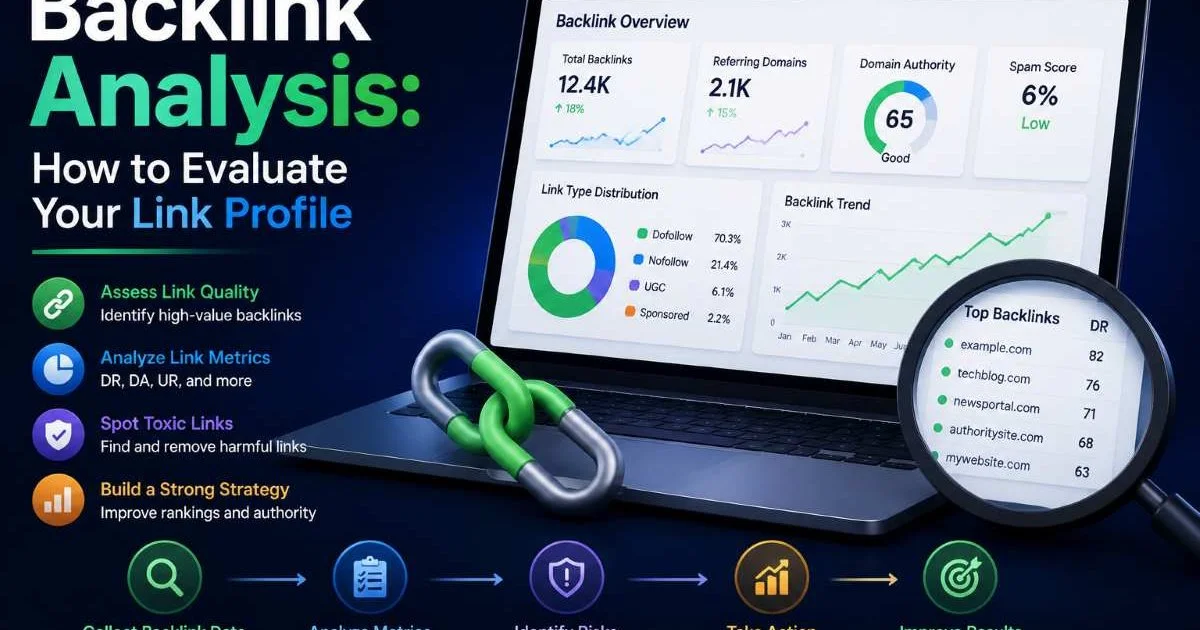
Backlink analysis is one of the most telling exercises you can perform when diagnosing a website's search engine performance. Every link pointing to your domain acts as a vote of confidence, but not all votes carry equal weight. A single editorial mention on a high-authority news site can outperform hundreds of low-quality directory submissions.
For digital marketers and SEO specialists, understanding the composition, health, and trajectory of a link profile is fundamental to sustainable rankings. Without a structured approach, you risk missing toxic links that suppress visibility or overlooking gaps your competitors have already filled. As part of a broader SEO analysis framework, backlink evaluation provides the off-page dimension that completes the picture.
This guide walks you through four actionable steps to audit your link profile with confidence and precision.
Key Takeaways
- Not every backlink helps; some actively damage your rankings and need removal.
- Anchor text diversity signals natural link acquisition to search engines.
- Competitor link profiles reveal high-value link-building opportunities you may be missing.
- Regular backlink analysis catches toxic links before they trigger algorithmic penalties.
- Domain authority distribution matters more than raw link count for ranking gains.
Step 1: Gather Your Backlink Data
Choose the Right Tools
Before you can evaluate anything, you need a comprehensive dataset. Google Search Console provides a free starting point. Navigate to the "Links" section to download your external links report. While this data comes straight from Google, it lacks depth metrics like domain authority or spam scores that third-party tools provide.
Tools like Ahrefs, Moz Link Explorer, and Semrush offer richer datasets with quality indicators. Ahrefs indexes over 35 trillion external links, making it one of the most comprehensive sources available. Moz provides a proprietary Spam Score metric that quickly flags suspicious domains. Running your domain through at least two tools gives you overlapping coverage and helps catch links that one crawler might miss.
Use Google Search Console alongside a paid tool; free data from Google often surfaces links that third-party crawlers haven't indexed yet.
Export and Consolidate
Export your backlink data into a spreadsheet. Include columns for referring domain, target URL, anchor text, domain authority (or domain rating), first seen date, and link type (dofollow vs. nofollow). Merging exports from multiple tools into a single sheet eliminates duplicates and gives you one master view of your entire profile. This consolidated file becomes the working document for every subsequent step.
Sort the data by referring domain rather than individual URLs. A single domain linking to you 500 times from a site-wide footer carries different weight than 500 unique domains each linking once. Referring domain count is a stronger ranking signal than raw backlink count, according to multiple correlation studies. If you are simultaneously performing a technical review, pairing this data with insights from a full SEO audit creates a more complete diagnostic picture.
Step 2: Assess Link Quality and Relevance
Authority and Trust Metrics
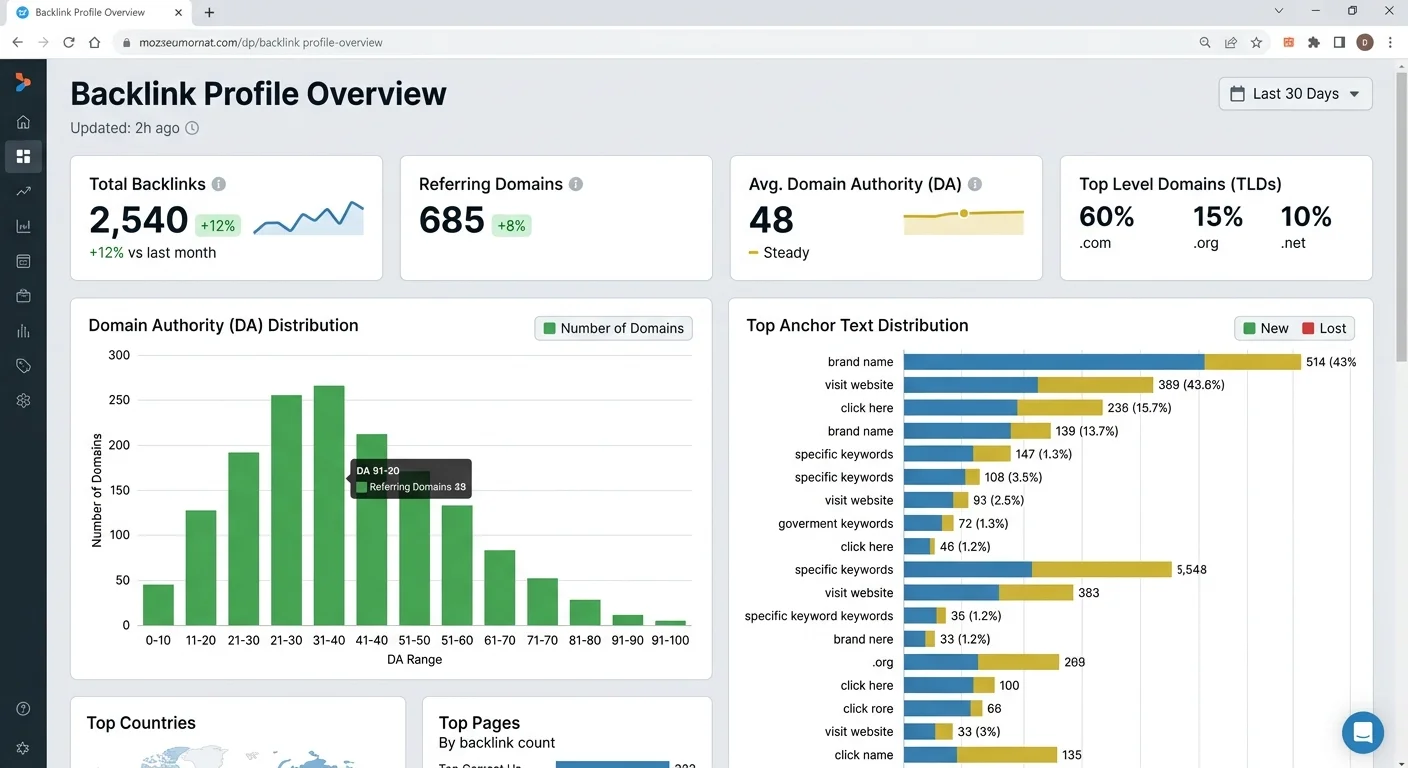
Raw numbers mean nothing if the links are low quality. Start by segmenting your referring domains into authority tiers. A common framework uses domain authority (DA) or domain rating (DR) on a 0 to 100 scale: links from domains scoring above 50 are high authority, 20 to 50 are mid-tier, and below 20 are low authority. The distribution across these tiers tells you whether your profile leans strong or thin.
Check for spam indicators. Domains with Moz Spam Scores above 7 (on their 1 to 17 scale) deserve manual review. Look for telltale signs: thin content, excessive outbound links, irrelevant foreign-language pages, or sites clearly built for link selling. Toxic links can be disavowed through Google's Disavow Tool, but use it sparingly. Only disavow links you have strong reason to believe are harmful, such as confirmed link networks or penalized domains.
Over-disavowing can hurt your rankings. Only disavow links that are clearly spammy or from known link schemes, never legitimate low-DA sites.
Topical Relevance
A link from a domain with high authority but zero topical overlap is worth less than you might expect. Google's algorithms increasingly evaluate contextual relevance. If you run an e-commerce pet supply store, a link from a veterinary blog carries more weight than one from a generic business directory. Review your referring domains and categorize them by industry relevance: directly related, tangentially related, or unrelated.
Technical factors also matter. Sites with TLS certificate errors or broken HTTPS implementations may pass reduced trust signals. A referring domain that serves mixed content warnings or expired certificates could be a signal of neglect, which diminishes the quality perception of its outbound links. Note these domains in your spreadsheet for further evaluation.
Topical relevance isn't just about keywords on the linking page. Google evaluates the overall topical authority of the referring domain.
Step 3: Analyze Anchor Text Distribution
Healthy Anchor Text Ratios
Anchor text is the clickable text within a hyperlink, and its distribution across your link profile sends strong signals to search engines. A natural profile includes branded anchors (your company name), naked URLs, generic phrases ("click here," "this article"), and keyword-rich anchors. Over-optimization of exact-match keyword anchors is one of the clearest footprints of manipulative link building.
| Anchor Type | Healthy Range | Risk If Over-Represented |
|---|---|---|
| Branded | 30% to 40% | Low risk |
| Naked URL | 20% to 25% | Low risk |
| Generic ("click here") | 10% to 15% | Low risk |
| Partial match keyword | 10% to 15% | Moderate if excessive |
| Exact match keyword | 5% to 10% | High, Penguin penalty trigger |
| Topic/phrase related | 5% to 10% | Low risk |
Calculate your current percentages by categorizing each anchor in your master spreadsheet. Most SEO tools automate this, but spot-checking the automated categories is worthwhile since tools sometimes misclassify branded terms that contain keywords. For instance, if your brand is "Keyword Tools Pro," an anchor using that name could be flagged as exact-match when it is actually branded.
Spotting Manipulation Signals
If exact-match keyword anchors exceed 15% of your total profile, investigate the source domains. Paid links, guest post networks, and private blog networks (PBNs) frequently use keyword-rich anchors because their purpose is to manipulate rankings rather than provide genuine editorial context. Google's Penguin algorithm specifically targets this pattern. If you spot clusters of identical anchor text from unrelated domains acquired around the same date, that is a red flag.
"A natural link profile looks messy. If your anchor text distribution looks too clean or too keyword-focused, that itself is a warning sign."
Corrective action involves two paths. First, disavow links that are clearly from manipulative sources. Second, dilute problematic anchor ratios by earning new links with branded or generic anchors through legitimate outreach, PR, or content marketing. Understanding how keyword research works helps you identify which terms are worth building natural anchor diversity around rather than forcing exact-match phrases into every link.
Step 4: Benchmark Against Competitors
Identify Link Gaps
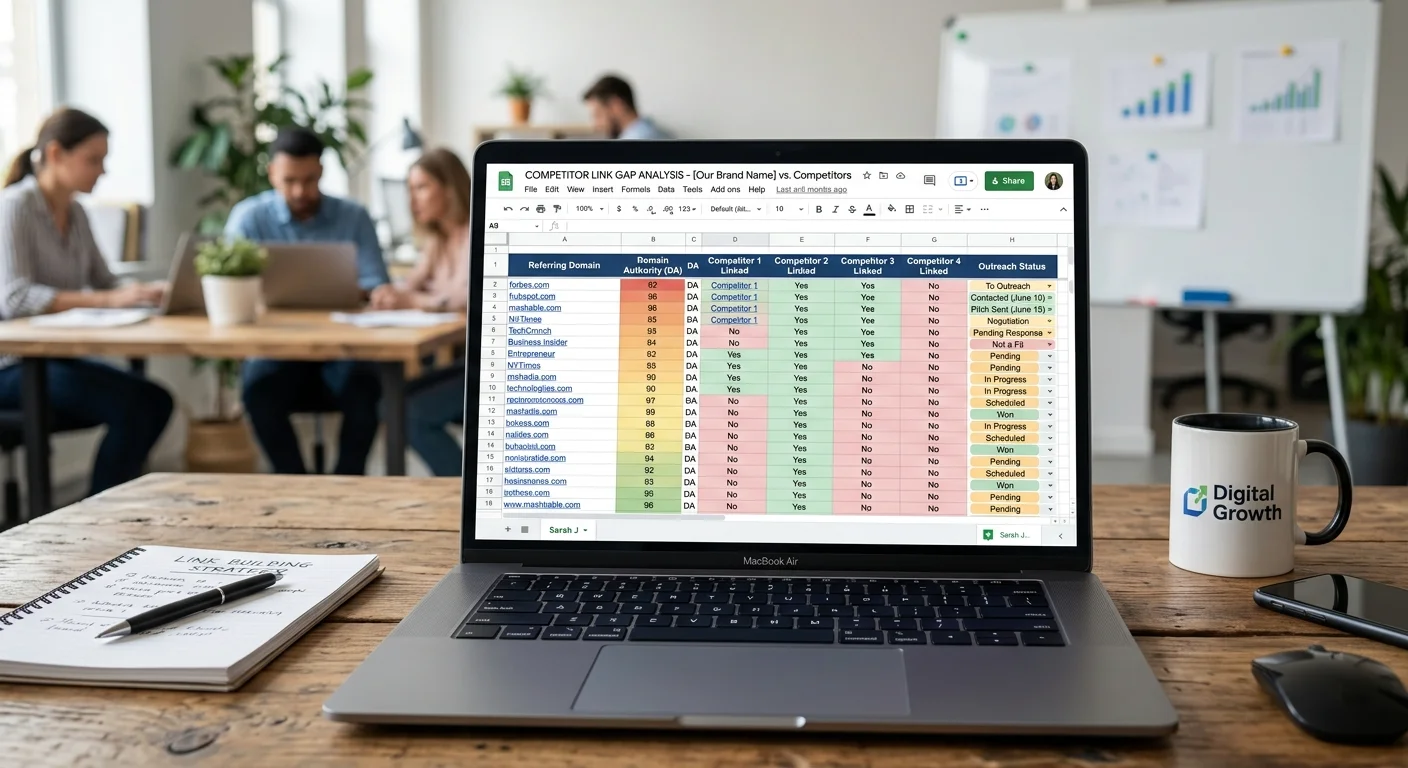
Your backlink analysis is incomplete without competitive context. Pull the backlink profiles of three to five competitors ranking for your target keywords. Most tools offer a "link intersect" or "link gap" feature that shows domains linking to competitors but not to you. These are your highest-probability outreach targets because the linking site has already demonstrated a willingness to link within your niche.
Sort the gap analysis by domain authority to prioritize high-value targets. A site with DR 70 that links to three of your competitors but not to you is a warmer lead than a DR 15 blog nobody reads. Typically, you will find 50 to 200 actionable link gap opportunities in a competitive niche. This process directly supports your ability to find ranking opportunities by revealing the off-page signals separating you from page-one results.
Build a Targeted Outreach Plan
Transform your link gap data into an outreach spreadsheet. For each target domain, note the specific page linking to your competitor, the context of the link, and what content on your site could serve as a replacement or addition. Personalized outreach that references the existing link and explains why your content adds value converts at roughly 5% to 10%, which is far better than spray-and-pray campaigns.
Consider your site's technical foundation as part of this effort. Progressive web apps and modern site architectures can present unique linking challenges, and resources like PWA SEO strategies for agencies illustrate how technical decisions affect link equity flow. If your site architecture prevents search engines from properly attributing link value to target pages, even great outreach will underperform. Make sure internal linking distributes authority from high-link pages to priority conversion pages.
Track outreach results in your spreadsheet with columns for date contacted, response, and outcome. This data improves future campaigns by showing which pitch angles convert best.
Schedule your backlink analysis as a recurring task, ideally monthly for competitive niches and quarterly for smaller sites. New toxic links appear constantly as scrapers, spam bots, and negative SEO campaigns evolve. Regular monitoring keeps your profile clean and your competitive intelligence current. Set calendar reminders and treat this like any other recurring audit task.
Frequently Asked Questions
?How do I consolidate backlink exports from Ahrefs and Semrush?
?Is Google Search Console enough, or do I need a paid tool too?
?How long does a full backlink analysis realistically take?
?Can a high referring domain count still hurt my rankings?
Final Thoughts
Backlink analysis is not a one-time project; it is an ongoing discipline that directly shapes your search visibility.
The four steps outlined here, from data gathering through competitive benchmarking, give you a repeatable framework for maintaining a healthy link profile. Focus on quality over quantity, watch your anchor text ratios, and always benchmark against the sites currently outranking you.
The marketers who treat link profile evaluation as a regular habit, rather than a crisis response, consistently build the most durable rankings over time.
Disclaimer: Portions of this content may have been generated using AI tools to enhance clarity and brevity. While reviewed by a human, independent verification is encouraged.