SEO ranking is not about guessing which keywords might work or blindly publishing content and hoping for the best. It's a disciplined process of identifying gaps, analyzing competitors, and finding the specific opportunities where your site can realistically climb the search results.
For digital marketers and SEO specialists, the difference between stagnant traffic and meaningful growth often comes down to how systematically you hunt for these opportunities. Every niche has overlooked keywords, weak competitor pages, and technical issues waiting to be exploited.
The question is whether you have a repeatable framework to find them. This guide walks you through four concrete steps to uncover ranking opportunities that actually move the needle for your business or clients.
Key Takeaways
- Audit your existing content to find quick-win pages already ranking on page two.
- Competitor gap analysis reveals keywords your rivals rank for but you don't.
- Technical SEO problems silently destroy your ability to rank for any keyword.
- Backlink profile analysis exposes link-building opportunities competitors have missed.
- Prioritize opportunities by search volume, difficulty, and business relevance together.

Step 1: Audit Your Existing Content for SEO Ranking Quick Wins
Find Striking-Distance Pages
The fastest path to more organic traffic is improving pages that already rank between positions 11 and 20. These "striking distance" pages have proven to Google that they're relevant, but they need a push to reach page one. Open Google Search Console, navigate to the Performance report, filter by average position between 11 and 20, and sort by impressions. The pages with the highest impressions in this range represent your biggest quick wins because demand already exists.
Once you have this list, examine each page for on-page optimization gaps. Are the title tags compelling and keyword-rich? Does the content fully answer the search intent behind the query? Understanding how SEO analysis works gives you a structured framework for evaluating these factors. Often, adding 300 to 500 words of genuinely useful content, updating statistics, and improving internal linking can bump a page from position 14 to position 7 within weeks.
Export your Search Console data monthly and track position changes for striking-distance pages in a spreadsheet to spot trends.
Identify Content Decay
Content decay happens when previously high-performing pages gradually lose rankings over time. This is common in niches where information changes rapidly, such as technology, finance, or marketing. Use a tool like Ahrefs or Semrush to identify pages that have dropped five or more positions in the last six months. These pages once had Google's trust, and refreshing them is far more efficient than creating new content from scratch.
When refreshing decayed content, don't just swap out a few dates. Restructure the article if the search intent has shifted, add new sections covering subtopics that competitors now address, and remove outdated advice. Industries that depend heavily on organic search, such as healthcare, e-commerce, and legal services, are particularly vulnerable to content decay because their informational landscape changes so frequently.
Step 2: Run a Competitor Gap Analysis
Map Keyword Overlaps and Gaps
Competitor gap analysis is where you stop looking inward and start studying what's working for others in your niche. Start by identifying three to five direct competitors who consistently outrank you. In Semrush's Keyword Gap tool or Ahrefs' Content Gap feature, enter your domain alongside these competitors. The tool will generate a list of keywords where your competitors rank but you don't appear at all. This list is a goldmine of opportunity.
Filter the results by search volume (aim for 100 or more monthly searches), keyword difficulty (under 40 for newer sites, under 60 for established domains), and commercial intent. Group related keywords into topic clusters rather than targeting each keyword individually. A single well-structured article targeting a primary keyword and five to ten related long-tail variations will outperform five thin pages every time. This clustering approach also strengthens your topical authority signals.
Analyze Content Quality Differences
Numbers alone don't tell the full story. Pull up the top three ranking pages for each target keyword and read them critically. Note their word count, structure, use of visuals, depth of coverage, and the types of sources they cite. If every top result is a 3,000-word comprehensive guide, a 600-word overview won't compete. Conversely, if the top results are bloated and unfocused, a tighter, better-organized piece can win.
Pay special attention to content formats. Some queries are dominated by listicles, others by how-to guides, and some by video content. Matching the format that Google clearly prefers for a given query significantly improves your chances of ranking. Also look for content gaps within the top results: questions left unanswered, outdated data, or missing practical examples. These gaps become your competitive advantage when you create something more thorough and current.
"The best SEO ranking opportunities hide where competitors got lazy, not where they got strong."
Step 3: Fix Technical SEO Issues Blocking Your Progress
Site Speed and Core Web Vitals
You can have the best content strategy in the world, but technical problems will undermine everything. Google's Core Web Vitals measure loading performance (Largest Contentful Paint), interactivity (Interaction to Next Paint), and visual stability (Cumulative Layout Shift). Pages failing these metrics face a ranking disadvantage, particularly on mobile. Run your site through PageSpeed Insights and address the specific recommendations, which typically involve image compression, render-blocking JavaScript, and server response times.
Mobile performance deserves extra scrutiny. Google uses mobile-first indexing, meaning the mobile version of your page is what gets evaluated for ranking purposes. A site that loads in 1.8 seconds on desktop but takes 6 seconds on mobile is effectively a slow site in Google's eyes. Compress images to WebP format, implement lazy loading, and minimize third-party scripts. These changes often produce measurable SEO ranking improvements within one to two crawl cycles.
Crawlability and Indexation
If Google can't crawl or index your pages properly, no amount of content optimization will help. Common issues include broken internal links, orphan pages with no incoming links, incorrect canonical tags, and bloated XML sitemaps that include noindex pages. You can scan your website for technical SEO problems using automated audit tools that flag these issues with specific fix recommendations. Run these audits at least monthly, or after any major site update.
Check your robots.txt file to confirm you're not accidentally blocking important directories. Review your index coverage report in Google Search Console for "Excluded" pages and investigate why they're excluded. Duplicate content issues are especially common on e-commerce sites and blogs with tag/category archives. Implementing proper canonical tags and using noindex directives on thin archive pages can consolidate your ranking signals and boost performance across your entire site.
A single misconfigured robots.txt line can deindex your entire site. Always test changes in Google's robots.txt tester before deploying.
| Issue | Detection Method | Impact on Rankings | Fix Difficulty |
|---|---|---|---|
| Slow page speed | PageSpeed Insights | High | Medium |
| Broken internal links | Site crawl audit | Medium | Low |
| Duplicate content | Canonical tag review | High | Medium |
| Missing meta descriptions | On-page audit tool | Low | Low |
| Orphan pages | Crawl report analysis | Medium | Low |
| Mobile usability errors | Search Console | High | Medium |
Step 4: Build a Strategic Backlink Profile
Find Competitor Backlink Sources
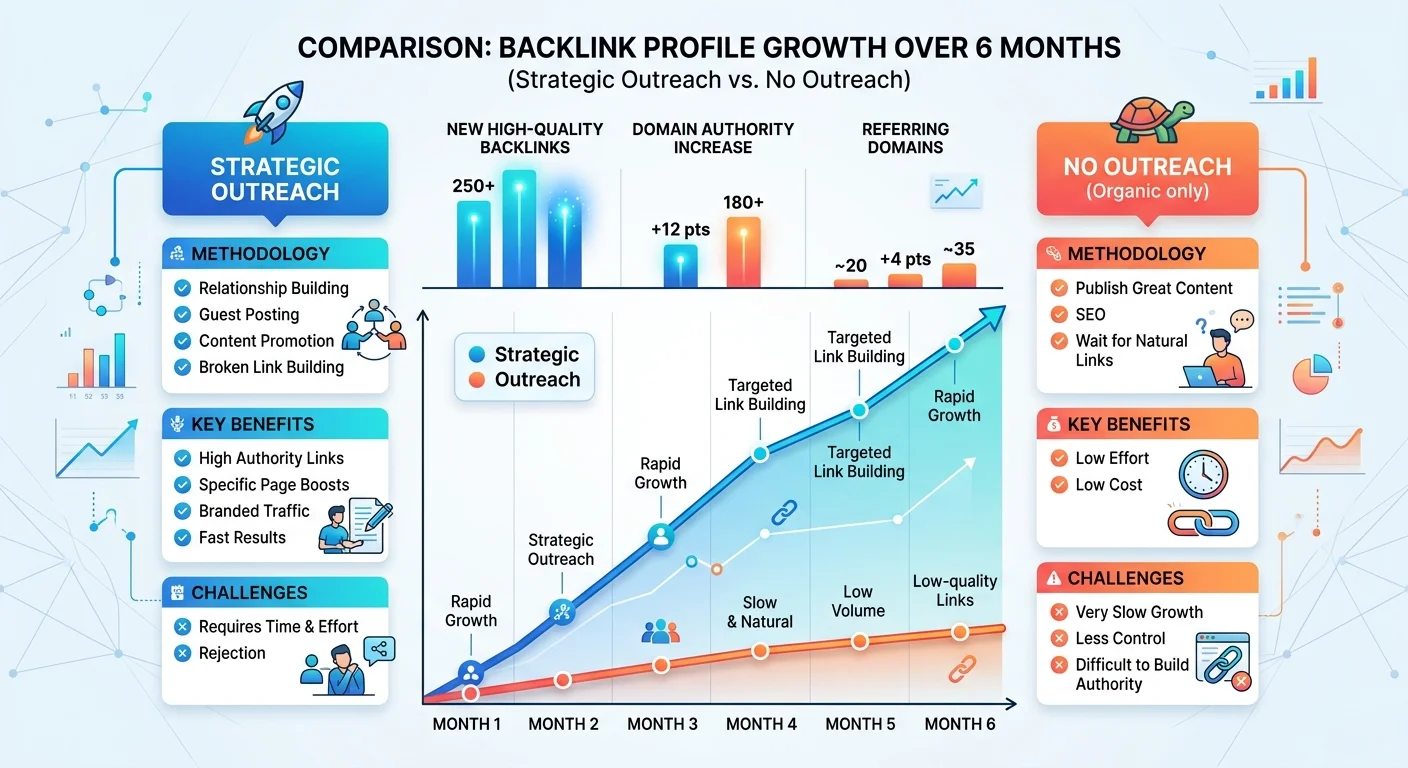
Backlinks remain one of the strongest ranking factors, and your competitors' link profiles are a roadmap to your own link-building strategy. Use Ahrefs, Moz, or Semrush to export the backlink profiles of your top three competitors. Sort by Domain Rating (or Domain Authority) and look for patterns. Are they earning links from industry publications, guest posts, resource pages, or directories? Each pattern suggests a replicable strategy for your own outreach.
Focus specifically on links pointing to pages that compete directly with your content. If a competitor's guide on "email marketing best practices" has 47 referring domains and yours has 3, that gap explains the ranking difference more than any on-page factor. Create a prospecting list of sites that link to competitors but not to you. Many of these sites would happily link to a superior resource if you reach out with a compelling pitch and genuinely better content.
Not all backlinks are equal. One link from a high-authority, topically relevant site can outweigh dozens of links from low-quality directories.
Prioritize High-Authority Links
Quality always beats quantity in link building. A single backlink from a Domain Rating 70 or higher site in your niche carries more weight than 50 links from DR 10 sites. Prioritize outreach to industry blogs, news sites, and educational institutions. Strategies that consistently produce high-quality links include original research (surveys, data studies), expert roundups where you contribute insights, and creating genuinely useful tools or calculators that people naturally reference and link to.
Track your link-building efforts in a CRM or spreadsheet. Record the target site, contact person, outreach date, response, and outcome. Most successful link builders report response rates between 5% and 15%, meaning you need volume in your outreach. Set a weekly goal of 20 to 30 personalized outreach emails. Avoid generic templates; reference specific articles on the target site and explain precisely why linking to your content adds value for their readers. This disciplined approach to building authority accelerates your SEO ranking trajectory significantly over time.
Frequently Asked Questions
?How do I find striking-distance pages in Google Search Console?
?Is refreshing decayed content better than writing new pages?
?How long does it take to move a striking-distance page to page one?
?Can technical SEO issues cancel out good keyword targeting?
Final Thoughts
Finding SEO ranking opportunities is not a one-time exercise but a continuous cycle of auditing, analyzing, fixing, and building. Start with your existing content because that's where quick wins live. Then expand outward through competitor analysis, technical fixes, and strategic link building.
The marketers who consistently grow organic traffic aren't necessarily smarter or better funded. They simply follow a disciplined process and act on the data rather than relying on intuition alone. Pick one step from this guide, execute it this week, and let the results compound.
Disclaimer: Portions of this content may have been generated using AI tools to enhance clarity and brevity. While reviewed by a human, independent verification is encouraged.